

What are the essential elements of the perfect concrete application and finish?
-> Exact Preparation -> Strength -> Solid Foundation -> Style -> Precision
- These are all elemental strengths that contribute to the objective to not only look great, but to last for decades! When matched with customed textures and colours, synthetics and admixtures – concrete can not only look decorative – it can actually “transform the space”.
In our continuing story on the Workability of Concrete, I thought I’d add a personal flavour. Recently I had my steep, paved driveway (approx. 50 degree slope) extended using a coloured, exposed aggregate mix – pic below. This little job however presented it’s own “sloping” challenge to a local expert – Joel of Decrowall Concrete Design.
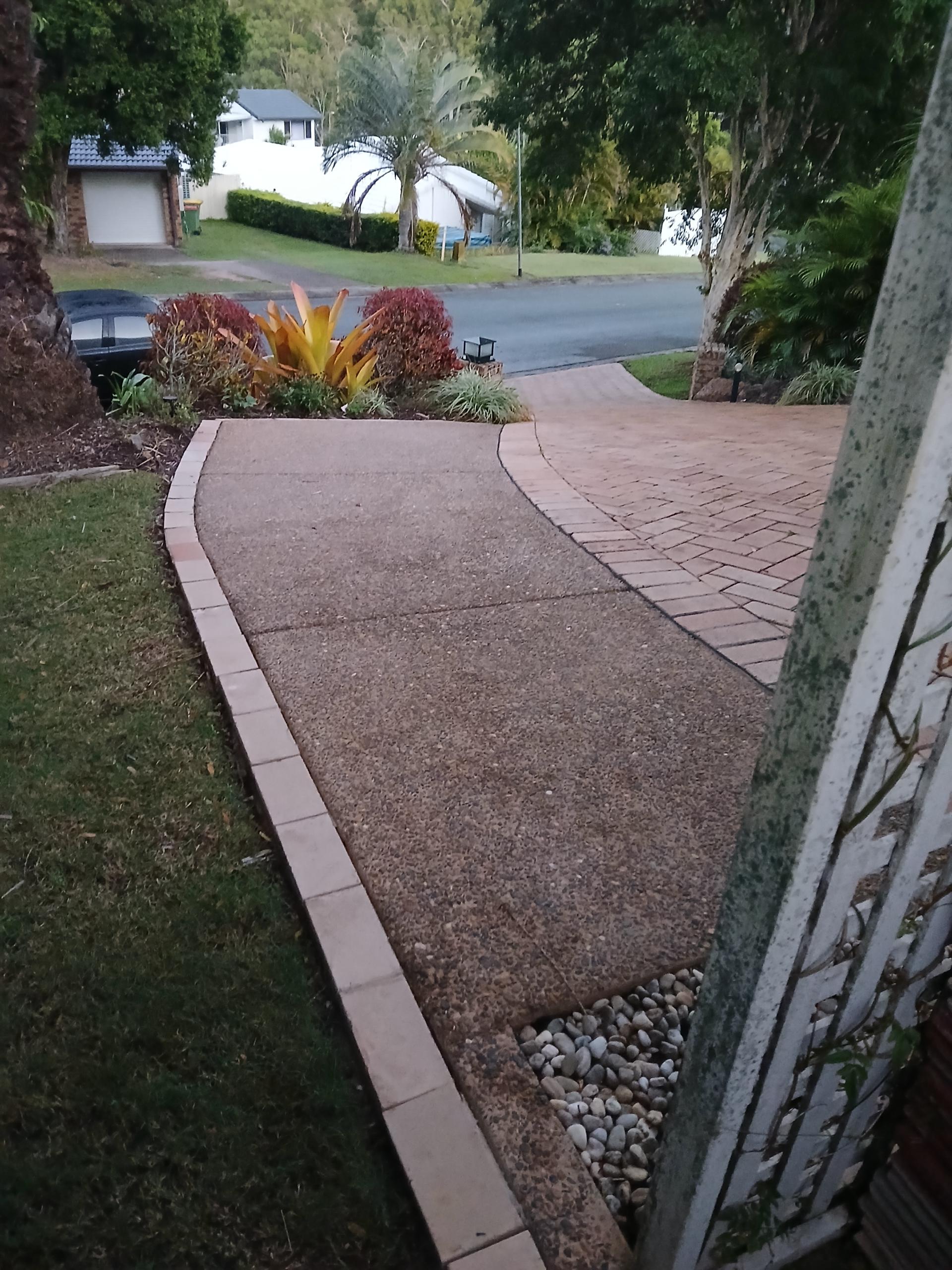
I recently caught up with Joel, who was engaged in a much bigger job than mine – on a 4 truck pour on another job up in Hervey Bay, Queensland. I asked Joel what is the “secret sauce” behind concrete workability.
First and foremost he replied, “is getting the slump exactly right for the job!” E.g. for my job on a steep slope he needed plenty of grabbing power & grip ability to overcome gravity – so on my job he used 80 slump.
Joel added a note of caution, in that these days there is a great disparity of concrete types due to additions of synthetic sands, crusher dust, water savers and retarders, that greatly affect the finish and in fact the entire end result!
Due to these additives, Joel said it is hard to gauge consistent slump. It even comes down to the batch plant you obtain your concrete pour from – as even different batch plants within the same company have differing concrete admixtures! A lot of the time Joel said he had to adapt the mix as it presents for the pour on the day and work with it to effect the best result.
Joel says that workability of slurry in the mix is also of great importance. Accelerators or retarders can result in a spongy feel to the concrete mixture. Usually he will try for a 2-3 hour drying time “if the environment, the weather and the stars align!”
These days Joel says he is a little disappointed in the quality of latest mixtures. With all the advances in admixture quality and materials; he finds it is actually getting harder to achieve that perfect consistency of slump. It sometimes takes him and his team up to 5-6 passes to sufficiently close up some concrete mixtures, where previously 2 passes would have covered it.
So the message from Joel in workability of concrete applications is that you have to adjust the mix on site, depending on the environmental factors that dictate the most effective pour. As Joel also added in conclusion: “Remember, if you don’t prep it right it won’t come out right”
Why It Matters & How to Get It Right
Key Takeaway
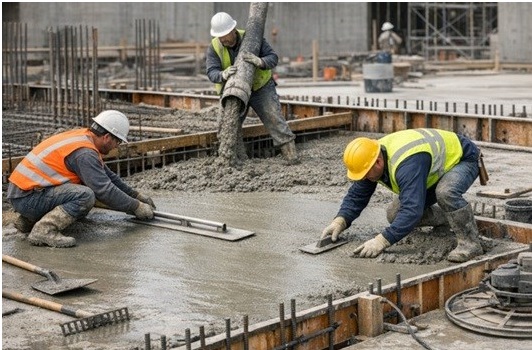
Workability = how easily concrete can be mixed, placed, consolidated, and finished.
It influences strength, quality, appearance, and labour cost.
- Water content, aggregate shape/size, and admixtures are the biggest drivers.
- Slump, K-slump, and SCC tests help quantify workability.
- Mix design, admixtures, and aggregate selection are the main improvement levers.
- Workability and strength must be balanced — especially the water-cement ratio
What Is Workability?
Workability describes how easily fresh concrete can be handled through every stage of placement.
It is the ability to “mix, place, consolidate and finish concrete easily.”
Workability determines how well concrete can be:
- Mixed — achieving a uniform, cohesive blend
- Placed — flowing into forms and around reinforcement
- Consolidated — removing air voids for density and strength
- Finished — achieving the required surface quality
What shapes workability?
- Cohesiveness
- Consistency
- Flowability
- Mobility
- Pumpability
- Cement paste volume
- “The freshly mixed quantity is crucial as it determines the ease of manipulation, placement, and homogeneity of the concrete.”
Why It Matters
- High workability allows concrete to flow around reinforcement and fill formwork effortlessly
- Low workability may cause stiff mixes, increased compaction effort, and potential defects
like honeycombing. - Optimizing workability is a key factor in long-lasting and structurally sound concrete.
Factors That Influence Workability
Water content — more water = higher workability.
- Aggregate shape & size — rounded and larger aggregates improve flow.
- Surface texture — smooth = better workability.
- Mix proportions — cement paste volume is critical.
- Admixtures — plasticisers, water reducers, air-entrainers.
- Temperature – High temperatures cause rapid moisture loss and reduce workability.
- Mixing Time and Methods – Proper, uniform mixing ensures consistent workability.
“Crushed aggregates, when proportioned appropriately, bond well with cement, enhancing the workability.”
“How Workability Is Measured”
Common tests include:
- Slump Test: Common field test; higher slump indicates better workability.
- Compaction Factor Test: Measures degree of concrete compaction; ideal for stiff mixes
- Flow Table Test: Measures spread and flow; key for self-compacting concrete.
These tests guide mix adjustments and ensure consistency across batches.
Types of Workability
Low Workability (Harsh) Concrete
- Low water content
- High segregation risk
- Difficult to place and compact
- Can cause “honeycombs and pockets in the finished concrete”
Stiff mixes for precast elements or sloped surfaces, requiring vibration for compaction.
Medium Workable Concrete
- Most common
- Easy to mix, place, and compact
- Water-cement ratio: 0.40–0.55
Balanced mix suitable for most construction applications.
Highly Workable Concrete
- Ideal for congested reinforcement
- Risks: bleeding, shrinkage, sensitivity to mix changes
Easily placed, suitable for complex forms and dense reinforcement. Achieved with superplasticizers, higher water content, or lower aggregate content.
“Improving Workability”
- Adjust Mix Proportions
o Balancing the water-cement ratio is essential. Too much water increases workability but reduces strength. - Use Admixtures
o Plasticisers and water reducers improve fluidity without increasing water content. - Select Proper Aggregates
o Rounded, smooth aggregates improve workability; angular or elongated aggregates reduce it.
“Workability vs Strength Curve”
Workability vs Strength
Workability and strength are inversely related:
- Higher water content → higher workability
- Higher water content → lower compressive strength
- The optimal water-cement ratio for strength is 0.40–0.60.
Effective compaction (vibration, rodding, tamping) is also essential for density and durability.
“Self-Compacting Concrete (SCC)”
Developed in Japan in the 1980s, SCC flows into complex formwork without vibration.
Benefits:
- Faster production
- Improved safety
- Reduced noise
- Excellent for congested reinforcement
Testing methods: slump flow, V-funnel, L-box.
What Is Workability?
Workability describes how easily fresh concrete can be handled through all stages:
- Mixing
- Placing
- Consolidating
- Finishing
Fresh concrete properties directly influence “strength, quality, appearance, and labour cost”. Workability is shaped by cohesiveness, consistency, flowability, mobility, pumpability, and the amount of cement paste.
What Influences Workability?
Several variables interact to determine how workable a mix will be:
Water content — more water increases workability; less reduces it.
Aggregate shape & size — rounded, larger aggregates improve flow; angular or small aggregates reduce it.
Surface texture — smooth aggregates improve workability; rough textures increase
friction.
Mix proportions — cement paste volume and aggregate ratios matter.
Admixtures — plasticisers, water reducers, and air-entrainers can significantly enhance
workability.
Crushed aggregates can bond well with cement, while smooth aggregates provide easier
movement within the mix.
How Workability Is Measured
Common testing methods include:
Slump Cone Test — a qualitative indicator of consistency.
K-Slump Tester — provides a more direct indication of water-cement ratio.
SCC Tests — slump flow, J-ring, V-funnel for highly fluid mixes.
These tests guide mix adjustments and ensure consistency across batches.
Real-World Lessons
Poor workability leads to:
- Reduced strength
- Segregation
- Honeycombing
- Compaction difficulty
Optimising workability is essential for structural performance and construction efficiency
FAQ’s
What is workability?
A material’s ability to be shaped, placed, and finished effectively.
What determines concrete workability?
Water-cement ratio, aggregate characteristics, sand gradation, and mix proportions.
How is workability measured?
By observing the shape of concrete after removing a standard slump cone.
Is high workability good?
Yes — when properly designed. High-workability mixes are easy to place and compact but must be engineered to avoid segregation.
In Summary:
Striking the right balance requires integrated thinking across material science, structural design and site logistics. The optimal concrete mix maintains high workability for ease of construction, while preserving mechanical strength, longevity, and resistance to environmental stresses.
Engineers often utilise mix designs with advanced admixtures to finetune workability, without compromising performance.
This understanding aligns with the principles of concrete applications, underscoring the critical role of controlled workability in achieving both structural excellence and practical constructability.
Also adapted from a blog by Certified Material Testing Products — July 29, 2025