

Top 5 Advances in Concrete Technology for Modern Buildings
Concrete is transforming. Once just a structural backbone, it’s now becoming smarter, cleaner, and more adaptable — driven by breakthroughs in material science, automation, and digital engineering. Here’s a quick look at the innovations reshaping modern construction.
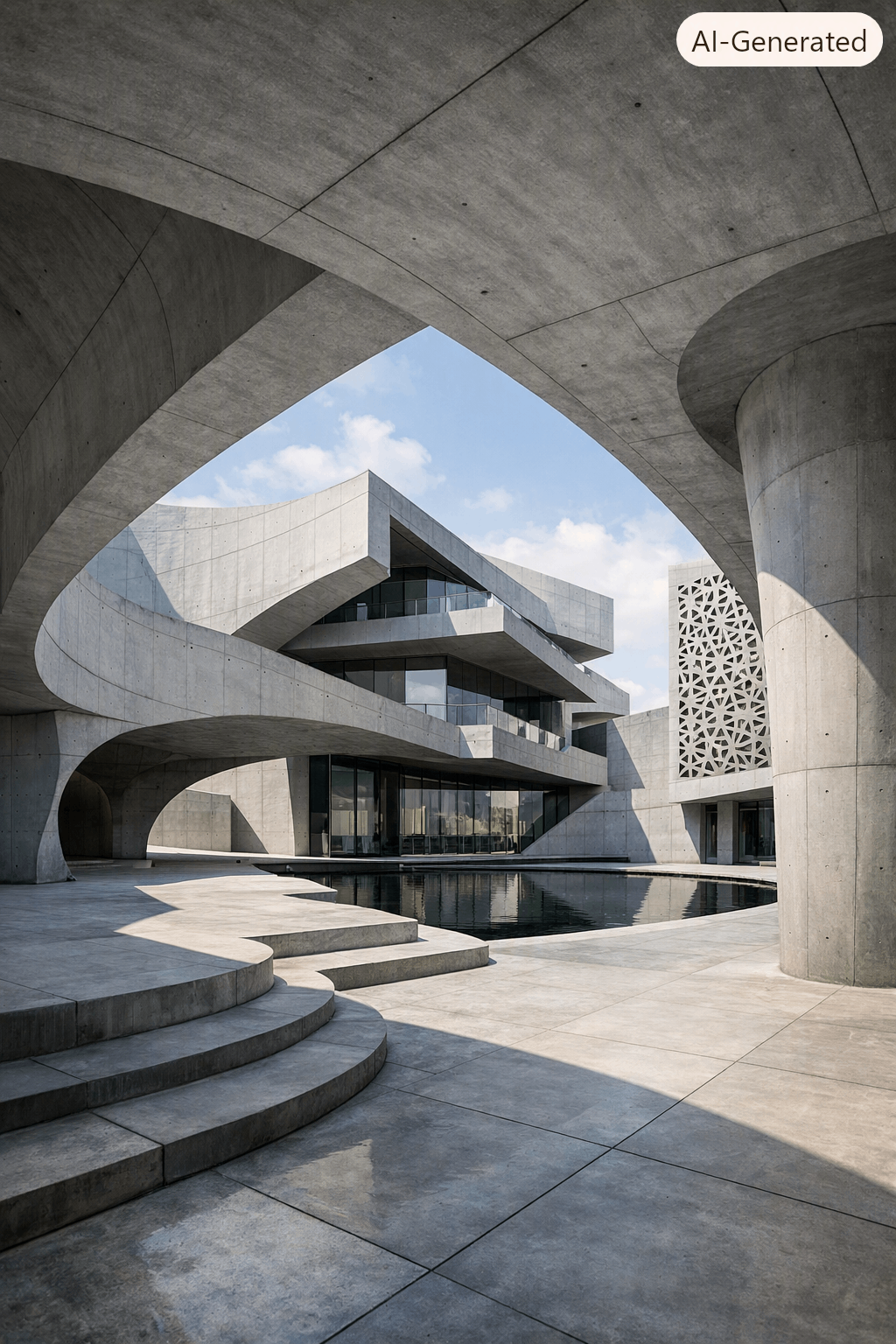
Concrete is evolving to meet the demands of modern architecture: strength, sustainability, flexibility, and digital integration. From self-repairing surfaces to automated placement systems, these advances are redefining how buildings are designed, built, and maintained.
1. Self-Healing Concrete
Longer Lifespans, Lower Costs
Why it matters: Cracks lead to corrosion, structural weakness, and expensive repairs.
What’s new:
- Capsules, bacteria, or polymers seal cracks automatically.
- Ideal for seismic and coastal environments.
- WPI’s enzyme-based additive forms limestone within 24 hours, repairing cracks up to 1mm and increasing strength.
Synopsis: –
Self-healing concrete shifts the focus from repairing damage to preventing it altogether. By embedding capsules, bacteria, or polymer agents within the mix, the material activates automatically when cracks appear, sealing them before they compromise structural integrity. This proactive approach dramatically reduces maintenance demands and lowers long-term lifecycle costs.
2. 3D-Printed Concrete
Precision, Speed, Zero Waste
Why it matters: Traditional formwork limits design and creates waste.
What’s new:
- Layer-by-layer digital fabrication.
- Complex geometries: curved walls, lattices, organic forms.
- COBOD BOD2 printer delivering multi-story buildings with integrated insulation and conduits.
- Embedded sensors track strain, temperature, moisture, and load changes.
- Predictive maintenance replaces periodic checks.
- Vemaventuri Monitoring Hub integrates with BIM to create live digital twins.
Synopsis: –
The technology uses computer-controlled extrusion nozzles to place specialized concrete mixes layer by layer, forming entire structural components — and even complete buildings — directly from digital models. Beyond residential construction, 3D printing enables highly customized architectural features such as doubly curved walls, lattice frameworks, and organic geometries that are difficult or impossible to achieve with traditional casting.
3. Smart Concrete
Structures That Talk Back
Why it matters: Manual inspections miss early warning signs.
What’s new:
- Embedded sensors can track strain, temperature, moisture & load changes.
- Predictive maintenance replaces periodic checks.
- A Vemaventuri Monitoring Hub can integrate, embed & analyze curing in real time with sensors that monitor various parameters, including strain, temperature, moisture, chloride penetration, and stress loads.
Synopsis: –
Smart concrete transforms traditional structures by embedding sensors directly into the mix during pouring, allowing the material to monitor strain, temperature, moisture, chloride levels, and stress loads in real time. This continuous stream of data feeds into building management systems, enabling predictive maintenance and delivering long term insight into structural performance. By replacing periodic manual inspections with automated monitoring, smart concrete significantly extends service life and reduces inspection costs — a key reason major infrastructure projects are increasingly adopting these systems.
4. Sustainable Concrete Mixes
Cutting Carbon Without Sacrificing Strength
Why it matters: Cement production accounts for ~8% of global CO₂ emissions.
What’s new:
- Alternative binders and recycled aggregates reduce emissions by up to 70%.
- Carbon Cure injects captured CO₂, strengthening concrete and permanently storing
carbon. - Over 30 million cubic yards used globally, locking away 375+ million pounds of CO₂
Synopsis: –
Concrete production accounts for roughly 8% of global CO₂ emissions, largely driven by cement manufacturing. New sustainable mix designs address this challenge by incorporating alternative binders, optimizing particle packing, and using carbon-sequestration technologies. These next-generation formulations can match — and in many cases exceed — the performance of traditional concrete while reducing environmental impact by as much as 70%.
5. Robotics & Automation
Smarter, Safer Job Sites
Why it matters: Concrete work is repetitive, labour-intensive, and hazardous.
What’s new:
- Robots handle placement and rebar tying with millimetre accuracy.
- ARTEMIX uses LIDAR + GPS for autonomous concrete distribution.
- MAX Co.’s tying robot uses computer vision to eliminate placement errors.
Synopsis: –
Concrete work has long been labour-intensive, making it an ideal candidate for automation. Today, robots perform tasks such as concrete placement and rebar tying with exceptional precision and far less physical strain on workers. They excel at repetitive or hazardous activities and automatically capture quality-assurance data throughout the process, improving both safety and consistency on the job site.
Overall Summary
Concrete is no longer a passive material — it has become an active participant in the performance, sustainability, and intelligence of modern buildings. The latest breakthroughs show a clear shift from traditional construction toward systems that think, adapt, and endure.
Self-healing mixes reduce lifecycle costs by repairing damage before it spreads. 3D-printed concrete unlocks architectural freedom while eliminating waste.
Smart concrete delivers real-time structural awareness, turning buildings into data-rich assets.
Sustainable mixes cut carbon emissions without compromising strength, proving that environmental responsibility and performance can coexist.
Robotics and automation bring precision, safety, and consistency to job sites that have historically relied on manual labour.
Together, these advances signal a future where concrete is not just a building material but a technological platform — one that supports longer-lasting structures, minimizes environmental impact, and enables buildings to actively respond to their surroundings. As these innovations continue to mature, they will redefine how cities grow, how infrastructure performs, and how the construction industry meets the demands of a rapidly changing world.
Adapted from a story on AzoBuild website – you can check out the link Top 5 Advances in Concrete Technology for Modern Buildings